HIMAPALA UNESA

Himapala Unesa adalah organisasi bergerak di bidang outdoorsport dan sosial.

ORGANISASI

Proin luctus placerat arcu, eget vehicula metus rhoncus ut. Fusce pharetra pharetra venenatis. Sed condimentum ornare ipsum.

Maecenas nisl est

Vestibulum suscipit ullamcorper bibendum. Nam quis commodo ligula. Etiam et mi et magna molestie iaculis.

Lorem ipsum dolor sit amet

Duis fermentum sem nec ipsum lacinia fermentum. Lorem ipsum dolor sit amet, consectetur adipiscing elit.

Popular Posts

Blog Archive

Sample Text

Tampilkan postingan dengan label American English. Tampilkan semua postingan

Back in the USA


The BBC has curated a veritable gripefest of peeves about American English in response to Matthew Engel's article and broadcast about his dislike of the spread of American English into mainstream British usage .

As picked up on here last week and discussed at much more length and in more academic detail at Language Log, Engel's piece was fairly reactionary in tone and seemed to be rallying the troops to defend the borders against foreign invasion. And it seems to have done its job, because many readers have sent in their contributions, ranging from fanny packs, medal used as a verb to 24/7 instead of the much catchier and quintessentially English all day every day. Jeez....

Edited on 21.07.11 to add: taken to bits on Language Log here!

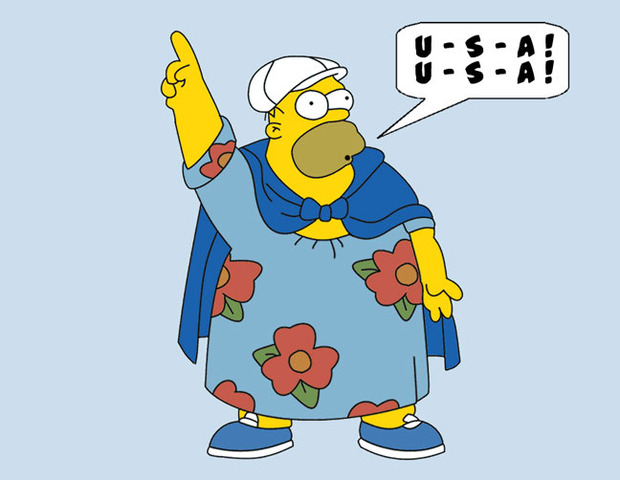
USA! USA!

There's a good article by Matthew Engel on the BBC News magazine this week which takes a look at the UK's attitudes to American language imports.

He tells us at the beginning that "The Americans imported English wholesale, forged it to meet their own needs, then exported their own words back across the Atlantic to be incorporated in the way we speak over here" which is a model that is fairly well-established in existing writing about American English, but one that comes with a few problems attached.

In one sense it still presumes that English English (or British English) is the standard to which all other varieties aspire and that while the Americans have been busy forging away (possibly a loaded metaphor, suggesting that they're making an inferior copy rather than bashing it with lump hammers and making it new) our language remains unchanged, aloof and just better, dammit. And what do we mean by "our" language anyway?

The title of the article is intriguing, because it suggests - as Lynne Murphy has identified in her tweets about this piece - that Americans aren't people, or at least they're not the "people" to whom Engels was addressing his piece. It's a strange piece of audience positioning for an author who must know that the BBC site is read all across the world... even by Americans. It smacks a bit of marking out territory and dividing lines between languages...which is OK, if that's what floats your Mayflower.

Also, towards the end when he makes a point about enjoying the "vigour and vivacity" of American English (words that always get used, often along with "articulate" when describing a language, or speaker of a language, that you think is good at "keeping it real" but probably not as clever as you) Engels states "...what I hate is the sloppy loss of our own distinctive phraseology through sheer idleness, lack of self-awareness and our attitude of cultural cringe. We encourage the diversity offered by Welsh and Gaelic - even Cornish is making a comeback. But we are letting British English wither". This strikes a fairly prescriptivist note, and suggests that as we import American words our home-grown variety dies out. Is it really like that?

I know that I cringe when I hear UK teenagers talk about the feds rather than the old bill, filth or boy dem (all good, old-fashioned British names for the police) but does that mean that the US word has taken the place of an English word, or just that its temporarily occupying its place while fashions come and go?

In one way, Engels is right that American words are creeping in through popular culture and spreading throughout British society, but in other ways he's not: regional varieties of English are apparently growing in strength, with some dialect terms making a comeback. While the bigger picture might be of a drift towards more Americanisms, it's not all one-way traffic and the drift is not uniform.

The article - despite my misgiving here - is certainly worth a read for anyone looking at global Englishes and the spread of American English around the world, as well as those looking for a good topic for a future Language Discourses question on ENGA3.

You can find a lot more about American English (and British English too!) on Lynne Murphy's excellent blog Separated by a Common Language and by following her on Twitter.

Edited and republished 13.07.11 because I've struggled to distinguish between save and publish on Blogger's new interface. D'oh! No, I mean "dash it!"

You say tomato; I say potato

The British Library's research into accents in the UK has attracted media interest, with some of the first findings being made public. This report in the Daily Mail takes a look at some of the results and offers the view that we aren't adopting American pronunciation as rapidly as some had assumed. Of course, this being the Daily Mail, they have to build in some kind of reactionary nationalism, stating that "many British English speakers are refusing to use American pronunciations" (my italics) which suggests that it's a conscious decision, when change often doesn't work like that.

Jonnie Robinson, curator of the Evolving English exhibition at the British Library (and speaker at the Emagazine Language conference this Wednesday) is quoted in the story:

British English and American English continue to be very distinct entities and the way both sets of speakers pronounce words continues to differ. But that doesn’t mean that British English speakers are sticking with traditional pronunciations while American English speakers come up with their own alternatives. In fact, in some cases it is the other way around. British English, for whatever reason, is innovating and changing while American English remains very conservative and traditional in its speech patterns.
John Wells looks at The Guardian's coverage of the study here and is a bit more sceptical about what the results tell us.

On a similar theme, but this time focusing on dialect and spelling, the Conservative MEP Daniel Hannan writes in the Daily Telegraph about the influence of  the internet on spreading American English (rather than English English) around the world.

NY speak

There's a nifty article in last week's BBC News magazine about changing accents in New York which is well worth a look. While the AQA A spec hasn't tended to cover American varieties in the past, there is now a World Englishes topic on ENGA3 where this might come in handy. From a different perspective you can also see more general patterns of language change in the ways that the NYC accent is reported to have changed over time. Anyway, the story is here and there is some video to go with it.

Sheeeeeeeeiiiiiiiiit

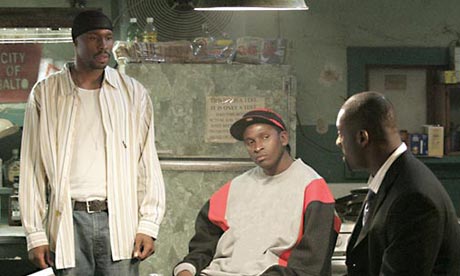
Here's a job that will appeal to the many fans of The Wire that have sprouted up in south London since we forced all A level students to watch it in class. The US Drug Enforcement Agency has advertised for speakers of "Ebonics" to sign up as translators in an attempt to decipher the language of African American drug dealers. But don't worry. They're not assuming it's only African Americans who are selling drugs: they're also recruiting Ibo, Berber and Farsi speakers, as well as lots of Spanish speakers, obviously.

The Guardian article covering this story makes some interesting points about what this tells us about attitudes to African American speech:

Ebonics is described by some linguists as English incorporating the grammar of African languages, but as it also includes many words invented on the streets, it is dismissed by others as mere slang.

Nonetheless, the administration is confused enough to ask firms providing translation services to provide the nine Ebonics translators to cover an area from Washington DC to New Orleans and Miami and even the Caribbean.

The move is a contentious one. American officials have in the past denied that there is any such thing at Ebonics.

There's more on Ebonics here if you're interested. Meanwhile, I am busy writing my letter of resignation (this is becoming a habit) and sending an application to Baltimore. Aight?

"Tidal waves of mindless Americanisms"

And following on from the mention of this in Alison Flood's article about attitudes to language change, here's a typically prescriptive perspective from the vile Daily Mail, laying the blame for the decline of our once great language squarely at the door of Johnny Yankie and his foul, colonial distortions of our beautiful tongue. And here's a second link to an earlier (and funnier) rant about American English.

I could care less


Thought I'd better post this very funny David Mitchell rant about American English here rather than leave it as a link on a comment squirreled away under a post. Thanks to the anonymous A level student who recommended it.

Beeb in bother about b-boy banter

A story (well, kind of a bit of a non-story) in the Daily Express suggests that BBC radio listeners are getting angry about the prevalence of American slang on the airwaves. According to the Express, listeners were outraged by a Radio 4 presenter's use of "fess up" instead of "admit to" and "face up" instead of "confront". And apparently, although the source isn't named, a Radio 1 presenter used "LA street slang". Fo shizzle?

The Express doesn't provide any links or further information, and you'd expect that as it's a rubbish, Tory-supporting newspaper run by a pornographer (or so I'm reliably informed by a man down the pub), but I've done a bit of homework on this and found some of these outraged listeners. Here's a couple of excerpts for you:

 (posted by "Ged")
I find this type of language to be offensive actually.
I detest street language, as it is often used as a form of violence.
I should imagine the person speaking was using to give themselves a deluded sense of street credibility.
As to why people need to project an affinity with people who can barely communicate is beyond me.
Any person attempting to use this language on national radio should be chased out of the studio with a very large stick! 

(posted by "Brian Duncan")
A language which has ceased to absorb neologisms is a dead language. A person who has ceased to countenance change might as well be dead.

A 42-year-old "trying" to behave like an eighteen-year-old is perfectly normal. What would be abnormal would be a 42-year-old doggedly clinging to the mores and manners of his eighteen-year-old self. What is ridiculous is any 42-year-old saying, "OOh! I'm 42. I must now cease from behaving like a 41-year-old, and start behaving as dictated by the age-police."

By what code of practice ought we to govern our dress or speech-habits, and where can I obtain a copy of that document?
For instance, I'm 64, and I play electric bass. Ought I switch to the 'cello - or maybe the harmonium?

Great stuff for a bit of discussion about Language Discourses on ENGA3, I'd have thought.

To the barricades!

The French have long complained about the encroachment of English words into their language, and have had a running battle with terms like le weekend and le parking. Now they're using technology to fight the spread of English. Oh they're so cunning, these Johnny Foreigners.

According to an article in The Daily Telegraph, also covered here in The Mirror, a new French-friendly spell-checker has been devised to replace English words such as email and carjack with their proper French equivalents: courriel and piraterie routiere respectively. Even last year's big word, subprime (the apparent cause of our current world credit crunch and *apparently* the reason why some scrote at Abbey National won't let us get some extra money to double glaze our Dickensian windows) has a French equivalent, the catchy prix hypotecairé à risque. Mmmm, that'll catch on... like the colds my unfortunate offspring now have thanks to the *sniff* windows.

But while the French alternatives may seem a bit clunky and awkward, many French people see them as a necessary evil in the long war to defend their language, culture and identity from the spreading, globalising power of English, as the article reports:

"I think that the defence of a language is the sum of a multitude of small battles, and it's worth the fight", culture minister Christine Albanel told the Telegraph. Even if only two out of ten words stick, the language has moved and breathed and we have marked our territory", she said at a ceremony to launch the "week of French language". Each French ministry has its own commission of terminology and neologisms, whose job is to track down English terms and offer French alternatives. They send their proposals to the Académie Française, a council of guardians of the French language, who debate the new terms and rubber stamp them. Once published in the statutes book, French civil servants are obliged to use them. About 300 such official French terms appear each year.

But what of the significance of this to English Language students? After all, this is English Language at SFX, not Francais Parole à Sexytime (or whatever). Jonathan Swift tried to introduce an English Academy centuries ago, in an attempt to regulate the English language. As you know, it didn't happen, and the debates about our changing language have raged ever since. But would an Academy, along the lines of the French system, have any real impact on our language? Would it be a good idea for a government body to regulate our language, deciding on what's acceptable usage and which new words would be invented?

I don't think so. So much of our language change is actually very democratic: it's a bottom-up spread rather than a top-down imposition of government diktats. Just take a look at how slang evolves: the language of the streets gets picked up by older and more middle class users and then filters through the media into general usage.

But this article also flags up another issue around language change, that of technology and language. Many of us have as our default spell-checker US English - it looks like The Telegraph's sub-editor has it too, given their use of program (the American spelling) as opposed to programme (the English spelling) - and this is having some kind of impact on the way our language is evolving, as this link explains.

And it's not only American spellings - humor, color, recognize - but American lexis. I become a raging prescriptivist when I hear young people talking about the police as the Feds. The Feds?! We don't have a Federal Bureau of Investigation in this country dammit. We have cops. We have rozzers. We have the old bill.Get with the program already, or something...

But is American English really a threat to English as much as English is seen as a threat to French? We've been using American terms for a much longer time than many of us realise as this 1995 article by Henry Porter points out (and this worksheet goes with it if you're looking for a way to use it in a lesson or for revision) and our language has expanded to accommodate it. We may have our own personal prejudices about words that sound American, but that's probably a generational thing. In a sense, because we have no Academy to tell us what is right or wrong, we all have the choice for ourselves, to express ourselves in ways that we want and with whatever mixture of English English, American English or even Franglais (ooh la la) that we want.

Useful for:
ENA5 - Language Change
ENA6 - Language Debates