


Tampilkan postingan dengan label language discourses. Tampilkan semua postingan
Tampilkan postingan dengan label language discourses. Tampilkan semua postingan

"This is where moral relativism leads us."
Terence Blacker of The Independent wades unhelpfully into the slang ban row, blaming negative reactions to the proposed "ban" (which didn't really seem to be a ban in the first place) on "moral relativism".Playground prescriptivism?
A story doing the rounds yesterday suggested that a school in Sheffield was attempting to prevent its students from using slang. It was covered in the local Sheffield Star here, with a reference to one of Sheffield's most famous exports, Sean Bean (aka Boromir , Ned Stark and Sharpe) and in yesterday's Daily Telegraph, Daily Mail and Guardian.Like many other arguments about language use, this one has become a bit muddied. In this case, the original story about the school - Sheffield Springs Academy - seemed to focus on slang (which might de defined as a type of extremely informal language used by specific groups of people) and a desire on behalf of the school to show its students that different styles of language suit different situations (what linguists often call the notion of appropriacy). However, the reporting of the story also refers to dialect being banned and regional pronunciations being frowned upon, and that's before you chuck in text speak too.
So what is actually happening here and can schools really control what their students say? The story is very similar to one we featured on this blog a few years ago about a school in Manchester which had banned street slang from its classrooms (covered here and in the Radio 4 programme Mind Your Slanguage which featured interviews with some SFX students) so it's perhaps not a big surprise to find that the head of the academy sponsors behind the Sheffield Springs Academy is the woman who was head teacher at the Manchester Academy when it introduced its ban, none other than Kathy August.
Her argument makes some sort of sense and goes something like this, according to the Telegraph report:
What we want to make sure of is that they are confident in using standard English. Slang doesn't really give the right impression of the person.So, according to August, it's all about reinforcing the students' grasp of Standard English and code-switching. The problem is - as several of the reports show - who defines what slang and regional dialect are? The references from parents in the Sheffield Star to teachers disliking regional accents and local dialect terms, and the strange notion brought up by August in the Mail's version of the story that "...when youngsters are talking together they use text speak..."(like B4,H8 and BTW? I doubt it...) suggest that there's much confusion over what actually constitutes slang.
Youngsters going to interviews for their first job need to make a good impression so that employers have confidence in them. It's not difficult to get youngster out of the habit of using slang.
Mrs August said it was preferable for pupils to say "thank you" instead of the more colloquial "ta", and "goodbye" rather than "see ya".
The trust said its policy on slang was part of its "street stops at the gate" ethos.
It also asks sixth formers to dress in suits rather than school uniform to encourage professionalism.
Mrs August added: "It is about knowing what language is acceptable between friends and what is required in more formal situations.
We want to give each of our students the best start possible; understanding when it is and is not acceptable to use slang or colloquial language is just one part of this.
This isn't a new confusion, and it's one that the linguist, Paul Kerswill noted in his response to a report on non-standard English in schools.The problem is that if all non-standard forms of English are lumped together there's a risk that the debate itself loses its focus. Are we talking about text speak in spoken conversations? Really? Or are we talking about the ways in which people from Sheffield might say about and right differently to those in the south? If it's slang then there might be a good argument for explaining how it is viewed or understood (or not) outside particular social groups, but there's also a decent argument put forward by Christopher Howse in today's Telegraph (albeit in his usual verbose style) that language play should be encouraged at school and that slang can be part of that.
No one is really going to argue that students don't need Standard English, but is their grasp of it so shaky that they should be encouraged not to use any other varieties of English that might interfere with the standard form? Is it really that bad? Obviously, the Daily Mail might want us to think it is, because that supports their reactionary, declinist agenda - English is in tatters thanks to immigrants, teachers who don't wear ties and Brussels bureaucrats - a classic "crumbling castle" argument. But are young people so vulnerable to the pernicious influence of non-standard forms that they should be protected from them at school?
What do you think? Comments (in Standard English, please - no text speak or ghetto grammar) are welcome.
People first and PC
This link on the excellent Linguistics Research Digest blog takes a look at the "people first" movement in Politically Correct (PC) language reform, which (as Jenny Amos explains) involved a switch in the type of noun phrase being used to label social groups, from pre-modified noun phrases to post-modified noun phrases. Pre-to-the-what-now?It's quite a simple idea. If you look at a noun phrase such as disabled people, the adjective disabled premodifies the noun people. The people first approach would be to shift the noun to the front and add the modification afterwards in the form of a prepositional phrase, so it becomes people with disabilities. The argument here was that the former version placed emphasis on the condition - and by extension defined the people by their disability - while the latter foregrounded the people themselves, with the disability coming after.Jenny Amos's blog post then looks at some interesting research by Helena Halmari into the use of such terms in news reporting.
PC is clearly about more than just rearranging words; it's primarily about rearranging ways of thinking about different groups in society, and specifically it's about removing offensive and derogatory words from the language. The arguments about PC were recently surveyed in an interesting Observer article by Miranda Sawyer, where she looked at some of the background to the PC movement and its more modern manifestations: Twitter spats, rape "jokes" and the bandying around of terms like mong and sket "for a laugh". If you're looking for material to bolster your ENGA3 Language Discourses understanding, go no further.
Prescriptivists' piffle versus descriptivists' data
With Language Discourses at the heart of the ENGA3 paper, it's always useful to scour the media to find examples of writers getting themselves worked up about language change or what they see as declining standards. If you've done any work on this topic so far, you'll already know that prescriptivists have always bemoaned changes to the English language but have rarely been successful in stopping its evolution.And you'll probably already know that most linguists - those who study language - are rarely of a prescriptive mindset. They tend to see their role as describing language, pointing out how it's used and by whom, rather than judging its use as good or bad. That's why we - your English Language teachers - generally tell you to talk about standard and non-standard instead of good or bad. Hark at us telling you what to do: how prescriptive...
This week there are two or three different pieces about changing language and attitudes towards it. Simon Kelner of The Independent writes not one but two articles about things he doesn't like in language: grocer's apostrophes (potatoe's, for example), split infinitives (to prissily prescriptivise, perhaps), Waterstone's dropping its possessive apostrophe, Americanisms, and all the usual suspects. It's a load of old gubbins really and reheats some frankly rather overcooked quibbles about language, most of which get dismissed by proper linguists.
A quick read of Henry Hitchings' The Language Wars or Robert Lane Greene's chapter A Brief History of Sticklers in You Are What You Speak (or better still, a long read of both) will tell you that nearly every prescriptive argument about declining standards can be successfully debunked. There's nothing wrong with splitting infinitives (it's a an old canard based on the misapplication of Latin grammar to English), most of the supposed "Americanisms" moaned about here (for example) are not really from America at all and apostrophes are a recent and rather inconsistent form of punctuation (as David Crystal explains here).
Elsewhere, Sali Tagliamonte, who is a leading light in the field of technology and language, talks some sense about how technologies such as texting create a repertoire for young people to draw upon, rather than necessarily restricting them or dumbing them down. In her interview with the St Catharine Standard, she talks about how young language users switch between language styles depending on their understanding of what's appropriate in a given situation, making the point that "They don't just adapt haphazardly. They adapt systemically".
This is clearly a much more descriptive standpoint and one that is supported by her detailed research in the field, more of which can be found here.You can also watch a clip of Sali Tagliamonte talking about her new book (complete with tinkly electric piano music) here.
The whole prescriptive versus descriptive debate is one that we have covered many times on this blog and one that always has some relevance to the A2 year of the English Language course (be it ENGA3 or ENGB3). If you click on the labels for language discourses and language debates after this post, you can find many of the relevant articles.
Edited on 20.01.12 to correct embarrassing apostrophe error. I blame my teecherz.
Apostrophe disappears: world ends
Apostrophe-lovers are up in arms over Waterstones' ...Waterstone's's...the decision of Waterstone's bookshop to remove the apostrophe from its name. In a move that some punctuation purists have likened to the end of the world, Waterstone's (named so because it used to be the firm of one Tim Waterstone, therefore - like Sainsbury's and McDonald's - a possessive apostrophe) have decided to ditch the dinky little punctaution mark.This article in the Daily Mail gives you more information and offers some hilariously unintentional punctuation errors in its readers' comments after the piece. One interesting angle is that the apostrophe is a useful shibboleth, allowing the (ahem) better-educated to look down upon their inferiors with wry disdain. But what use is the apostrophe? It's a relatively new invention, punctuation-wise, and doesn't conform to its own rules (it's ...its...see I'm confused now), but perhaps still serves a helpful disambiguating role in contractions like I'm and she'll, where the pronunciation of a word might be affected if there were no apostrophe.
We've looked at apostrophes before on this blog (here and here, for a start) and I'm increasingly of the view that they're dying and we should probably just get rid of them once and for all to save confusion. It's a good topic for ENGA3 Language Discourses questions (probably as part of Language Change) and would make a suitable topic for a Language Intervention on ENGA4 too.
Language Police
Just a quick link to a good piece in yesterday's Guardian Weekend by Oliver Burkeman about attitudes to language mistakes, grammatical errors and other abuses.Heated debates: mongs, spastics and housewives
The comedian Ricky Gervais has attracted criticism from a range of quarters for his use of the word mong in recent comments on Twitter. According to Radio 1 Newsbeat and The Sun, Gervais's "jokes" have included references to himself as being monged-up when pulling a face, welcoming his followers with good monging and many more hilarious quips that demonstrate his mastery of sophisticated wordplay.Gervais claims that the word isn't offensive and has no connection to people who suffer from Down Syndrome (who back in my school days used to - cruelly - be called mongoloids, mongols or mongs, apparently because of the facial resemblance between sufferers and Mongolian people), but he's old enough and clever enough to know that it is offensive for many many people. His argument - that language changes, get over it - is superficially attractive but ultimately disingenuous.
He knows that the word still carries connotations of abuse and is used to belittle and hurt, so why does he use it? Why not use twit, idiot or fool? And there are plenty of other ones to choose from too.
The Angry Mob blog runs a good feature on the story here and the comedian Richard Herring does a thoughtful post* about the language used to mock disabled people here:
I don't think any of them would do the same with the word "nigger" or "paki" but they're happy to use "mong" or "retard" as a means of getting a laugh. And audiences will laugh at those words too and rarely even complain about them. But I think they do equate with those racial and homophobic epithets that are rarely heard these days. They do confirm the stereotype of disabled people and contribute to their further isolation in a world that already tries to pretend they don't exist.
The argument over offensive words has previously included references the golfer Tiger Woods made about playing "like a spazz" - derived from the word spastic, another term that's been used offensively in playground abuse - terms like retard (a word that landed the Black-Eyed Peas in trouble, when really they should be in jail for their utterly appalling ear pollution, rather than linguistic crimes) and the long debate over the term nigger and its reclamation.
And of course, more recently we've had a big debate over the use of the word slut as part of the slutwalk movement and a revival of arguments over the word chav and its meanings.
Even apparently inoffensive terms like housewife have come in for criticism recently, with a Mothercare survey revealing that two thirds of mothers find the term insulting. In a response to this survey, Lucy Mangan of The Guardian** looks at (not very serious) alternatives to housewife, such as milch cow and baby wrangler, but serious alternatives have been considered in the past, as this story about the Women's Institute back from 2006 shows.
So, is Gervais the victim of the old PC brigade? Are the feminazi and do-gooding liberal elite stormtroopers of the Political Correctness massive swinging into action. Has, for probably the millionth time (if you read the Daily Mail), PC really gone too far this time?
Well, what is PC? Part of the problem with the whole debate around Political Correctness is that the term itself is troublesome and contested by different groups. PC was initially connected to the women's rights movements of the 1970s and sought to draw attention to the inequalities in language that seemed to exist between men and women, changing the language to avoid discrimination and offence. It later grew to take in terms connected to race, sexuality and disability.
Words like chairman were challenged, and uses of language that seemed to exclude or marginalise women and minority groups were discussed, and alternatives proposed. Many caught on in popular usage and have not been problematic since, but others proved more contentious. So when it was noted that a sentence like "Each student must bring his notes to class" might be perceived as sexist, the alternatives "their notes", or even invented gender-neutral pronouns like "hesh", attracted ridicule or grammatical pedantry ("How can their refer to one person when it it is a plural pronoun?" they asked).
As Deborah Cameron points out in her book on language intervention, Verbal Hygiene, the term Politically Correct was initially an ironic, self-mocking label applied by some feminists to poke gentle fun at their own "right-on-ness", but within the space of a few years opponents of PC - those who opposed changing some labels which might be considered offensive or insensitive, and who were often politically right wing and reactionary - were using it as a term of abuse. In essence what the anti-PCers were arguing against was any attempt to reform the language, because they saw it as part of a radical political agenda with which they disagreed.
If the term PC is used now it's used very much as a term with negative associations. If you're PC you're humourless, probably militant and unbending in your views and more than likely want to ban Christmas and turn it into Winterval to avoid upsetting disabled lesbian Muslims. But regardless, arguments over sensitive and derogatory language usage still rage, and whether we call it PC or just linguistic sensitivity, people will still get upset about certain words and what they can mean, while others argue for their right to say anything they like.
So for this month's heated debate, where do you stand?
Can we control or influence which words are used in society?
Is it a positive step to challenge uses of words like mong and spastic?
Alternatively, is PC just a means of clamping down on freedom of expression?
Does changing language have any effect on wider social issues like racism and sexism?
Over to you...
* Thanks to @SFXEnglish for the link
** and thanks to Jon Dolton for this one
Heated debates
Now the new term has started and I'm back teaching again (huzzah, I think) I'll try to update the blog with relevant material for AQA Language A and B specs a bit more frequently.The first thing I'd like to set up is a Debate of the Month, which I hope will help A2 students with Language Intervention coursework and the Language Discourses part of the ENGA3 paper. The plan is to highlight a particular topic each month and look at different arguments around the issue, flagging up various style models for written pieces and offering suggestions for different angles on each debate.
I'm hoping that any keen followers of the blog (and I know there are some out there...mother, can you hear me?) will also chip in and join the debate by adding comments and links. We can all dream, I suppose.
The first topic will be gender differences in conversation and I'll kick it off next week with a quick survey of the different positions and some of the recent debates about how men and women are supposedly hard-wired to use different conversational styles and why this is a controversial (and rather dubious) position.
If anyone would like to suggest links to articles, case studies or just offer a view, I'd be interested to hear.
Ghetto grammar
The linguistic fall-out from last week's riots continued yesterday with an article by Lindsay Johns in the Evening Standard proclaiming that "Ghetto grammar robs the young of a proper voice". While Johns' work in Peckham with disadvantaged young people has to be applauded, he's got a very narrow view of street slang and has prescriptive form - this article on supposed "gang slang" and this on "proper English" being cases in point (and covered here on the blog last November).While Johns talks a lot of sense about the power of language and the need to unlock potential in inner city teenagers who might be stereotyped and demeaned for their use of certain varieties of English, he's also unwilling to accept sound linguistic arguments about code-switching and sets up something of a straw man argument with his attack on what he calls "cultural relativism":
Some educators take a position of cultural relativism. They assert the legitimacy and value of street talk, or at the very least, the importance of teaching young people to "code switch" - how to differentiate in which milieu it is socially acceptable.
I have no time for such an approach. In my experience, young people find it very hard to code switch. Text-speak, poor grammar and street patois routinely pervade the essays I set them, let alone their conversations with me.
The problem here is two-fold. Firstly, you'd be pretty hard-pressed to find any linguist or educator who doesn't argue that a mastery of Standard English is a prerequisite of a good education. Who are these cultural relativists that Johns is referring to? It smacks of the right wing arguments about the "PC brigade": some nebulous and sinister cabal of liberals and lefties hell-bent on messing up everything about young people's education with their crazy commie views. They don't really exist...
Secondly, code-switching is not that difficult for young people. They do it all the time. But only if they have another form to switch into. That's essentially the point that Johns is missing. The young people he works with - if they have as poor a command of Standard English as he claims - don't have a problem with slang: they have a problem with basic literacy. To lay the blame for these young people's inability to write and speak clearly at the door of street slang and those people who don't condemn it out of hand is a very weak argument.
Blame the education these young people have received so far. Blame the system that values grades above individual achievement. Blame racist and classist stereotyping of young people. Blame the young people themselves for messing around, bunking off and generally taking the piss; but don't blame slang.
Such an argument is made weaker by the seemingly arbitrary list of features that Johns gathers as markers of this "ghetto grammar":
an inarticulate slang full of vacuous words such as "innit" and wilful distortions like "arks" for "ask" or tedious double negatives
Like so many other arguments about accent, slang and non-standard English, the list just serves to flag up a few personal peeves. A quick look at the comments after the article shows that there are plenty of others happy to jump on the bandwagon and list their personal dislikes in language use. And again, this is part of the wider problem. So many of these features are just down to personal prejudices and individual taste. I don't really have a problem with ain't and innit - perhaps because they're forms that I heard being used around me from quite an early age - but I bristle when I hear feds or po-po for police. So what? As William Labov showed in his studies of New York speech, the post-vocalic "r" (farm, park, card) was often viewed as a marker of upper-class speech , while here in Britain it's often been associated with rural accents and given much less prestige (Drink up thy ciderrrrr, ooo-arrrrrr). There are different ways to pronounce things and different words we like or dislike, but these aren't sound principles on which to build the "rules" of a language.
In many ways, Lindsay Johns adopts a Bernsteinian approach to language, talking about restricted and elaborated codes, and that's an interesting and valid angle, but in other ways he adopts a prescriptivist approach that undermines his wider argument. I can't argue with his desire to increase the linguistic skills of the young people he mentors, to increase their articulacy, self-esteem and employment prospects, but to blame street slang for where they are now just seems plain wrong.
USA! USA!
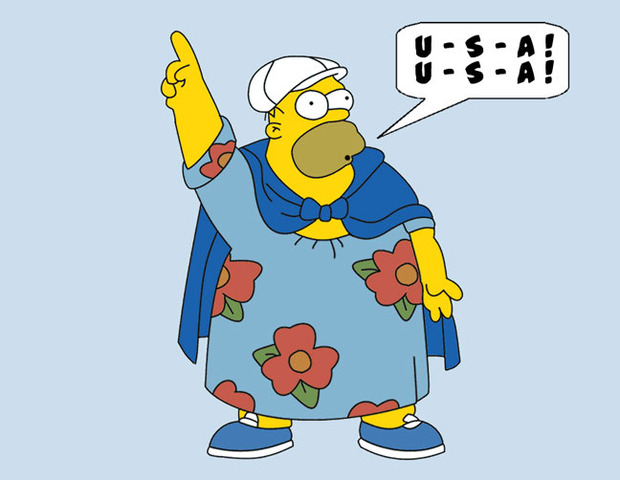
He tells us at the beginning that "The Americans imported English wholesale, forged it to meet their own needs, then exported their own words back across the Atlantic to be incorporated in the way we speak over here" which is a model that is fairly well-established in existing writing about American English, but one that comes with a few problems attached.
In one sense it still presumes that English English (or British English) is the standard to which all other varieties aspire and that while the Americans have been busy forging away (possibly a loaded metaphor, suggesting that they're making an inferior copy rather than bashing it with lump hammers and making it new) our language remains unchanged, aloof and just better, dammit. And what do we mean by "our" language anyway?
The title of the article is intriguing, because it suggests - as Lynne Murphy has identified in her tweets about this piece - that Americans aren't people, or at least they're not the "people" to whom Engels was addressing his piece. It's a strange piece of audience positioning for an author who must know that the BBC site is read all across the world... even by Americans. It smacks a bit of marking out territory and dividing lines between languages...which is OK, if that's what floats your Mayflower.
Also, towards the end when he makes a point about enjoying the "vigour and vivacity" of American English (words that always get used, often along with "articulate" when describing a language, or speaker of a language, that you think is good at "keeping it real" but probably not as clever as you) Engels states "...what I hate is the sloppy loss of our own distinctive phraseology through sheer idleness, lack of self-awareness and our attitude of cultural cringe. We encourage the diversity offered by Welsh and Gaelic - even Cornish is making a comeback. But we are letting British English wither". This strikes a fairly prescriptivist note, and suggests that as we import American words our home-grown variety dies out. Is it really like that?
I know that I cringe when I hear UK teenagers talk about the feds rather than the old bill, filth or boy dem (all good, old-fashioned British names for the police) but does that mean that the US word has taken the place of an English word, or just that its temporarily occupying its place while fashions come and go?
In one way, Engels is right that American words are creeping in through popular culture and spreading throughout British society, but in other ways he's not: regional varieties of English are apparently growing in strength, with some dialect terms making a comeback. While the bigger picture might be of a drift towards more Americanisms, it's not all one-way traffic and the drift is not uniform.
The article - despite my misgiving here - is certainly worth a read for anyone looking at global Englishes and the spread of American English around the world, as well as those looking for a good topic for a future Language Discourses question on ENGA3.
You can find a lot more about American English (and British English too!) on Lynne Murphy's excellent blog Separated by a Common Language and by following her on Twitter.
Edited and republished 13.07.11 because I've struggled to distinguish between save and publish on Blogger's new interface. D'oh! No, I mean "dash it!"
Performing mouth to mouth on grammar
If you're looking for more language discourses topics in readiness for tomorrow's ENGA3 exam, this might be a good link to have a look at. One of the debates that's been knocking around for a long time (probably forever) is that around the seemingly inevitable decline in standards of English grammar among the general population and whether or not we should care. In this article, the author, Barbara Gunn, suggests we need to "resuscitate" grammar.As an English teacher, I think grammar is important, but perhaps not for the same reasons that Barbara Gunn puts forward in her article. I can't help but shudder when I read someone using your instead of you're, or there instead of their, but perhaps that's my inner prescriptivist crying out and I should learn to ignore it, a bit like I ignore the cat as it mewls for food seconds after being fed. Prescriptivists have complained about the general public's inability to use grammar properly ever since English came into existence, but is it actually getting any worse?
Henry Hitchings - whose book, The Language Wars I've plugged endlessly on here - makes the point that people have been confusing should have and should of and you were and you was since the 17th Century. Perhaps it's because more of us write now than ever before (tweeting, emailing, texting and even blogging all being new forms of "writing") that these grammatical errors/non-standard forms are being noticed more. Maybe we are becoming less literate. I dont no.
If you have a look through this blog for posts about grammar usage (usually tagged prescriptivism or descriptivism) you'll find a number of articles about Simon Heffer's (appalling) Strictly English, and the Queen's English Society's most recent musings on our language going to the dogs, along with some descriptivist critiques of their arguments. As you're having a look at these, you'll probably notice the familiar models that Jean Aitchison pointed out in her classic Language Web lectures: the crumbling castle, the damp spoon and the infectious disease.
Political Correctness: theories and debates
I wouldn't normally copy a comment from another post over as a new post, but I think this might be helpful for tomorrow's ENGA3 if PC comes up as a topic.This is in response to a comment by Jessica on the ENGA3 Language Discourses post from earlier in the week, asking about which theorists might be helpful on a question about PC. She'd already mentioned Sapir & Whorf, Miller and Swift and Norman Fairclough. This is just my take on the theories and concepts that might help, so please add any comments or observations/criticisms to it as comments. I'd be interested to hear what anyone else has to say on arguments around PC.
I think you're fine with those theorists really, so long as you're clear that the underpinnings of the PC movement come from a belief that if you remove sexist & racist words from the lexicon, you'll either a) remove the pejorative association of that term, or b) go some way towards changing the discourse around sexism and racism by drawing attention to the problems inherent in those words.
E.g. You could argue that the debate about "slutwalking" has polarised opinion about the word slut and "slutty" dressing, but on a very simple level it has at least made everyone think about the word, what it means and whether or not it should be used. It's also given young feminists the chance to enter the debate about women's rights in a way that might not have been open to them before, thus intervening in the discourse.
I think the other thing is that it's important to realise that PC is quite a rarity in linguistic terms in that there has been a degree of success in imposing a "top-down" model of language change. You could argue to what extent it's been successful, but in many ways it's one of the few attempts at linguistic engineering that's actually worked.
Most of the time, language change is bottom-up - usage leads to adoption and codification of patterns of lexis and grammar - and organic.
This of course means that there are some who would normally see themselves as descriptivists aligning themselves with a rather prescriptivist stance - PC, after all, is all about prescription. So it makes for some unlikely bedfellows: normally prescriptive language commentators arguing that PC is a bad thing because it's telling us what we should and shouldn't say; normally descriptive linguists arguing that PC is a force for good.
That's why I think it's such an interesting debate.
Women: Speak Your Mind
Sunday's Observer had an article about new work by the linguist Judith Baxter on speaking patterns of men and women in business. It's a good read and exactly the kind of article that often appears in the ENGA3 Language Discourses question.What's particularly interesting about this article is that it's based on recent research by a respected linguist, but that it's also been given a populist spin through the incorporation of various quotations from other individuals, some of them non-linguists. It also links in wider discourses about women in the workplace and the impact of status and power.
If gender crops up again in ENGA3 (which I think is unlikely this year) this is the sort of article that I think would appear.
ENGA3 Language Discourses: some pointers
With ENGA3 coming up at the end of this week and several requests for help with section B of the paper, here are some pointers about the topics and what to revise.
There have been three ENGA3 papers set so far, and the topics for language discourses have been as follows:
Jan 2010
Popular psychology/ linguistic self-help books looking at male and female communication
Jun 2010
John Humphrys arguing prescriptivist views about language change
Jan 2011
Will Self and Lynn Truss discussing their attitudes to texting and txt language
There’s no point trying to “question-spot” and putting all your eggs in one basket, by proclaiming that as regional accents haven’t turned up yet it’ll definitively be that topic, but it can be useful to think about the types of questions that have been asked and those that haven’t yet.
So, the topics that haven’t cropped up yet are:
Changing varieties of English. There’s been quite a lot of discussion about how regional accents are thriving and local accents dying out, as well as new ones (like MLE/MEYD/”Jafaican”) emerging, and whether this is a good or a bad thing.
World English/es. This hasn’t cropped up yet and could appear as it’s on the spec. What could be asked about this? Well, there have been quite big debates around the world about the role of Standard English and whether we should be imposing World English (one variety) or showing awareness and understanding of different varieties (World Englishes) and how English changes thanks to local language and culture. There are also several interesting historical angles about why English has spread and whether this will continue in the same way.
New words and attitudes to them. While language change has cropped up before in the form of John Humphrys bemoaning the state of our common language and Truss and Self talking about texting and its impact on language, there is also scope for something on new words. Many new words have entered dictionaries in recent years and some commentators find this deeply discombobulating. “How can OMG and LOL be “words”? “ they cry. Dictionary compilers have argued in response that they’re reflecting the changing nature of our vocabulary and that they have a duty to record new words.
Political correctness and Linguistic engineering. The need (or otherwise) to impose changes on language and remove offensive terms is a very good topic for debate and leads to some very polarised opinions. One man’s throwaway remark about chavs is another’s systematic demonization of the working class. Likewise, terms for gender, race and sexuality have been discussed recently in regard to the changing roles and status of different groups in British society.
Variation that isn’t gender or region-related. The topic of language variation doesn’t just have to cover females and males or regions; other areas on the syllabus that could appear are age-related variation, work-related variation and what might broadly be termed “communities of practice”.
Technology and changing language. Texting cropped up recently, but other technological advances and forms of Computer-Mediated Communication, like Facebook and Twitter, could be a focus for debate.
Knowing something about the topics is only part of the knack to doing well in this exam. Equally, if not more, importantly, you need to know about how to analyse the language used to construct the debates. What are the writers saying and how are they expressing their views? What kinds of wider debates are these discussions tapping into?
Over the next day or two, I'll add some points about what often works on this paper and give some examples of how good students have approached language discourses.
Placing the accent on bigotry
Articles about different accents are often full of judgemental adjectives like "lazy", "pleasant" and "harsh" (and you can see what genuine linguists think of such vocabulary by having a look at Paul Kerswill and John Wells' comments about the recent Economist article on changing accents) but a piece by Telegraph journalist Ed West reaches some new lows.For him, "Jafaican" (or Multicultural London English) is "rather unpleasant, sinister, idiotic and absurd". His entire premise seems to be built upon the wrongheaded notion that MLE is something people "put on" - that it's a fake accent and one that reflects a desire to be street. As he puts it, "In London the adoption of Jafaican, even among the privately-educated, reflects both a lack of confidence in British cultural values and an aspiration towards some form of ghetto authenticity".
Frankly, this is a pile of steaming cobblers. Underpinning it seems to be a profound dislike for the speakers of MLE and a simmering resentment that otherwise decent posh people (white people, dammit) are picking up this dirty ghetto accent. It's almost like they want to be black. Shame!
The article annoys me too much to string many more sentences together, so I'm glad that a more restrained and analytical response to it is presented here by Ben Trawick-Smith on Dialect blog. He ends by characterises the article as not "a writer bravely fighting against an increasingly “PC” world... just an ignorant rant".
Berks versus w*nkers
 |
| Some appropriately named "members of the Berkeley Hunt" in action |
In it, he quotes Kingsley Amis who split the world of language commentators up into berks and w*nkers. (I'm asterisking w*nker to avoid this blog getting blocked by various school and college filters, when the etymology of the Cockney rhyming slang berk - short for Berkeley hunt is much ruder...you work out the rhyme or look here.)
It's a neat distinction and much more eloquently put than my own attempt on this blog post which used Hippies and Hitler at each extreme of the spectrum.
Greene concludes by saying
...that wherever we place ourselves on the berk-w*nker spectrum is arbitrary. It can only be defended with an appeal to a sense of style and taste, with a strong dash of self-deprecating humour. Anyone who gets red-faced insisting that their place on the berk-w*nker spectrum is the only place God intended language to be can be safely ignored.
Wise words.
Changing accents
Several newspapers have picked up onThe original Economist article is here under the title Geordie's Still Alreet. The Daily Mail jumped on the Geordie angle and the chance to print a picture of the delightful Cheryl Cole (whose recent tribulations with Simon Cowell and the US X Factor have been covered at length recently and at least partly blamed on her accent being tricky for Americans to understand) and featured the story under the title More than "Alreet".
Kerswill is one of the key linguists in the field and has been involved in a lot of recent work on Multicultural London English, among other things, so he knows what he's talking about. However, not all the articles based on his work are problem-free and it's interesting to see what Kerswill himself, and other linguists, have to say about the ways in which accents are described in the media. You can read more here on John Wells' phonetic blog.
Language Variation is one of the big areas for ENGA3 (sadly, it's not currently covered on the AQA B spec) and there's a decent chance of something about accent and dialect cropping up as a Language Discourses topic too this year. It's therefore worth looking at some of the complaints about the language used to represent different accents. Adjectives like sloppy, lazy, guttural and bland abound in many of these mainstream articles, and that's before you even get onto the readers' comments which are often laced with quite offensive stereotypes about the inhabitants of different regions and the way they speak.
We've covered the main thrust of Kerswill's argument here before, but it's certainly worth having a look at all of this again in preparation for the A2 exam later this month.
* edited on Thursday 9th June to reflect Paul Kerswill's comments below (sorry, Paul!)
Maximum chav-age

Looking at arguments about language change and political correctness is all part of ENGA3 Language Discourses, while the language used to represent social groups - in this case, the working class, or sections of it - is covered in the coursework for ENGA2.
At least be consistent

Kevin Myers, writing in today's Irish Independent, is not one of those people. In his article Omigod, this linguistic gibberish is, like, so gross he gets quite upset about what he calls the spread of "pseudo-American" English among the Irish middle classes and their teenage offspring, but he's initially exercised by the "common and lazy usage" of different than as opposed to different from, something he praises Michelle Obama for getting right while all around her everyone else is getting it wrong.
That's fair enough in many ways. Historically, there's been a pattern of usage that suggests different from is preferred to different than in formal English. However, that's changing and there appears to be a gradual shift taking place - perhaps through slips and errors, but perhaps through analogy with other, similar structures - towards different than. Language change is often a slippery beast and it can happen for all kinds of reasons.
Where Myers is on shakier ground though is in his insistence that "(Michelle Obama) correctly used the preposition rather than the relative conjunction, which -- for example -- the comparative adverb "better" would have attracted: hence, "different from" and "better than"." The problem here is that amid all his seemingly knowledgeable grammar talk, he comes up with a word class - relative conjunctions - that just doesn't exist. We've got relative pronouns (words like which and that, used to introduce relative clauses) and we've got conjunctions (and, but, because, if) but there's no such thing as a relative conjunction.
You could say that this just doesn't matter and I'd be tempted to agree. But if you're trying to come up with a rationale for a "rule" you follow - and more importantly, a prescriptivist rule you seem to want others to follow too - at least get it right.
For more on similar arguments about language usage (Language Discourses on ENGA3), you could have a look at this post about Simon Heffer's terrible Strictly English and this post about Henry Hitchings' excellent The Language Wars.
My get-out clause, before anyone points out any grammatical shortcomings in this (or any other) blog post, is that I'm not telling other people what they should or shouldn't do.
Langganan:
Postingan (Atom)